
Madaster and EPEA — Part of Drees & Sommer have implemented a project as part of the “Affordable Housing and Innovative Construction” strategy dialogue that opens up completely new opportunities for the federal state: the building materials register for Baden-Württemberg.
This cadastre creates transparency about the materials used and their quality and thus lays the foundation for a circular construction industry. In the future, municipalities will be able to access digital data to use buildings as raw materials stores and to strategically plan reuse.
Why is that so important?
The construction industry causes enormous amounts of CO₂ emissions and waste. At the same time, buildings are true deposits of raw materials. With the material register, linear construction becomes a circular system: materials remain in circulation, resources are conserved, and municipalities secure long-term economic benefits.
Baden-Württemberg as a pioneer
With the Strategy Dialogue, Baden-Württemberg is sending a strong signal: The turnaround in construction is not only an ecological issue, but also an economic issue. Municipalities that rely on circular concepts today reduce disposal costs, secure raw materials and create sustainable added value. The building materials register is a milestone on this journey.
From material depot to new added value
Each building is an “urban mine.” With transparency about the materials used and their quality, waste becomes a recyclable material. Digital platforms such as Madaster make this information accessible and create the basis for reuse. EPEA provides the strategic concepts and know-how to integrate this data into planning and implementation.
Recording the materials is just the first step. It is crucial that raw materials do not end up in waste but are returned to industry, the so-called industrial re-use. This is where new value chains are being created: Manufacturers are checking which components from dismantling projects can be economically reconditioned or processed into new products. Examples include broken concrete as an aggregate, separated bricks, components such as doors or windows, and metals and plastics for material recycling.
Municipalities play a key role in this: By actively using the material register, providing material data and integrating it into projects, they enable clear material flows and effective matchmaking with industry. In this way, added value remains in the region and materials from the city stay in the city.
Strategic advantage for municipalities
Urban mining offers the following benefits for municipalities:
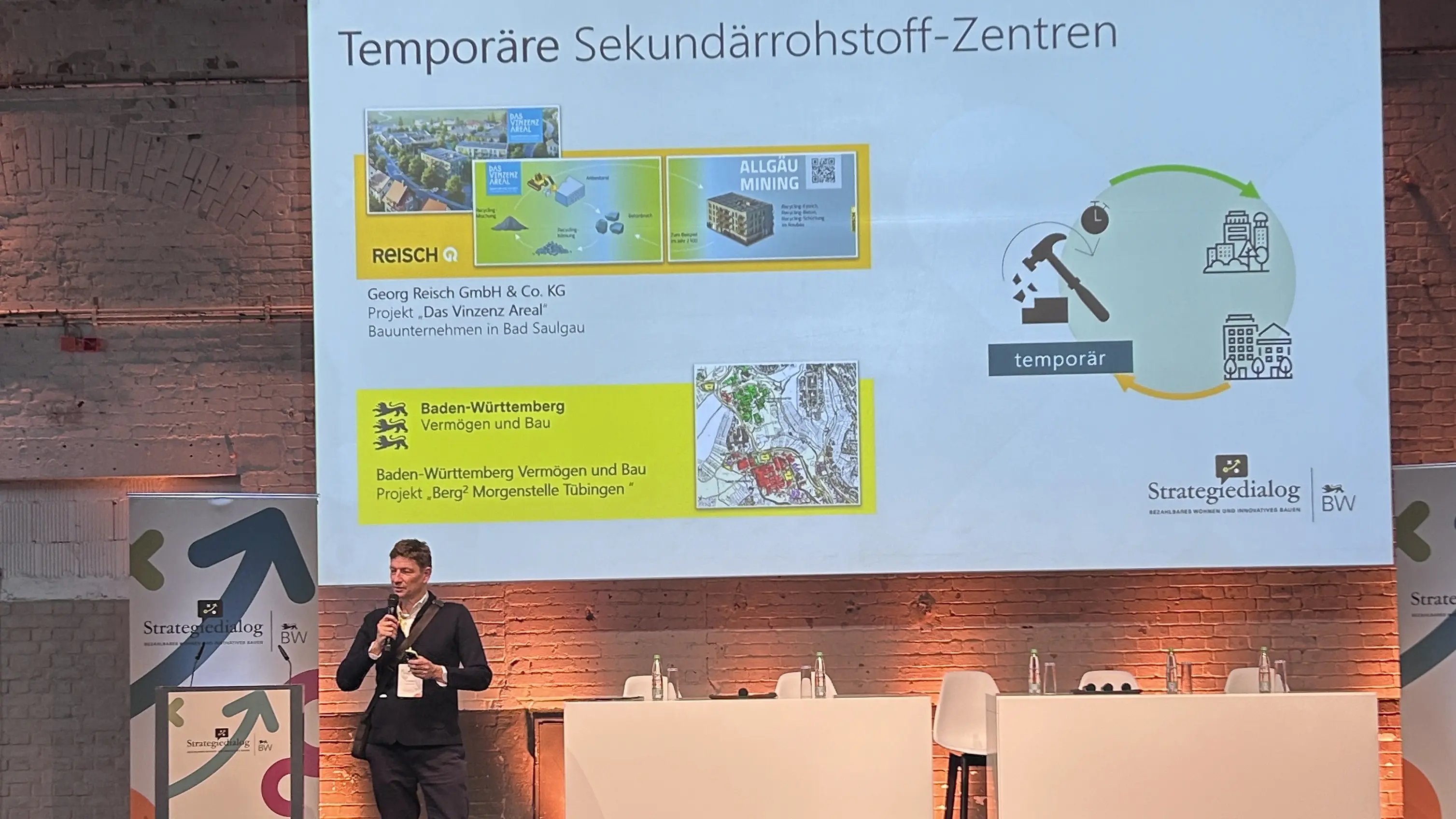
“In Baden-Württemberg, we want to establish secondary raw material centers that barely exist to this day. These centers process materials and prepare them for reuse. Where these centers would be arranged purely logistically is, of course, where many material flows from inventory will arrive in the future. And this is exactly the answer provided by the building materials register.”
Dr. Peter Mösle, Partner and Senior Executive, EPEA GmbH — Part of Drees & Sommer