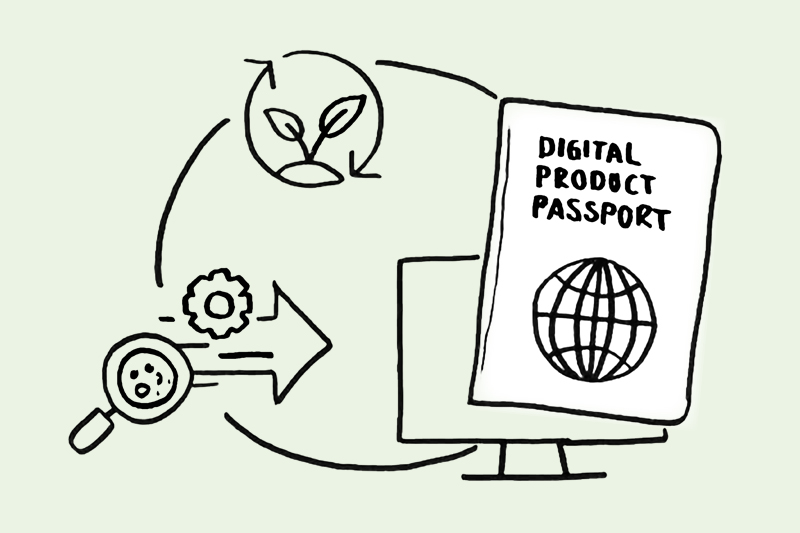
The transition from reactive recycling to proactive circular material management requires the exchange of data along the entire value chain. Digital product passports are a market mechanism that makes the circular value of materials, products and systems visible.
Great recognition for EPEA's pioneering work!
EU sets new standards for sustainable products
As part of the Ecodesign Regulation for sustainable products, the EU will introduce the requirement for a digital product passport (DPP) for all relevant products by 2030. The exact requirements for the DPP are still under development.
In a Cradle to Cradle based economy, materials flow between industries and countries. Digital product passports make these flows transparent and create economic benefits.
ISO 59040 as a basis
The new ISO standard defines a machine-readable format for circular product information, from recyclability to use of materials. It forms the basis for DPPs under the EU-ESPR.
EPEA as implementation partner
With over 20 years of experience in material and product passports, EPEA helps companies develop ISO-compliant DPPs, from data sets to system integration.
Transparency and digital product passports are an integral part of a functioning circular economy.
Hein van Tuijl
Managing Director, EPEA Netherlands
The path to international standards
Milestones of Digital Product Passports
EPEA introduced “Circularity Passport®” solutions back in 2019, in anticipation of the ISO international standard for circular data.
January 2025
ISO 59040 is published as part of the ISO 59000 family of standards, specifically developed to promote the circular economy.
July 2024
The Ecodesign for Sustainable Products Regulation (ESPR), which includes the DPPs, comes into force.
2019 — 2024
The Luxembourg Ministry of Economy leads ISO standardization for the international standard on circularity data.
2013 — 2019
Horizon 2020 project “Buildings As Materials Banks” tests an international standard for circularity data on 400 products and 6 buildings.
2010 — 2014
Application of material passports in Cradle to Cradle projects with Maersk, Delta Development Group, City of Venlo and various other product manufacturers.
2012
Springer encyclopedia publishes “Resource Re-Repletion. Role of Buildings and Introducing Nutrient Certificates a.k.a Materials Passports as a Counterpart to Emissions Trading Schemes” by Michael Braungart and EPEA scientists K. Hansen and D. Mulhall.