

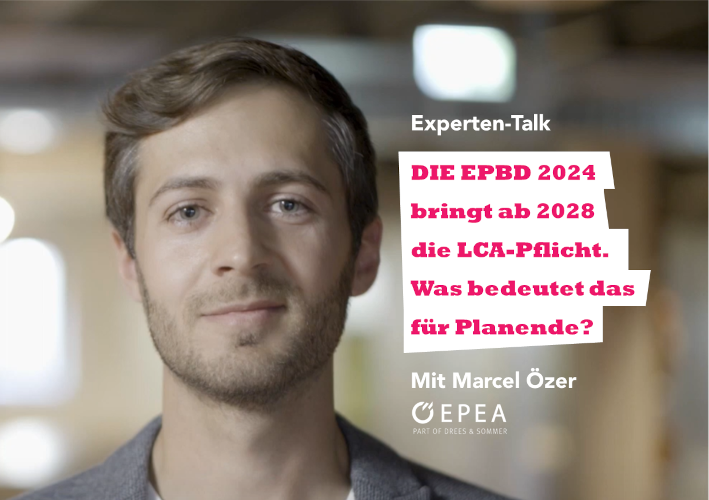
A contribution from The workbench: From material selection to dismantling — How EPBD digitizes the entire building cycle
Excel lists for material inventories, manual life cycle assessments, subsequent documentation — what has brought planning offices through everyday life for years will become a compliance trap in 2028. This is because the new Energy Performance of Buildings Directive (EPBD) makes life cycle assessments mandatory and building resource passes the standard. Marcel Özer from EPEA is convinced: Anyone who still thinks linearly from planning to execution is already planning for the past.
The new EPBD version adopted in May 2024 is the end of an era.
“EPBD is expanding the focus from pure energy efficiency to complete building decarbonization. It is no longer just about energy consumption during use, but about the complete CO₂ footprint — from material production to dismantling. ”
Marcel Özer, managing director and sustainability expert at EPEA
The time horizons are tough and have now been finally confirmed: From January 1, 2028, all new buildings over 1,000 m² must calculate life-cycle greenhouse gas potentials and show them in the energy certificate. From January 1, 2030, this applies to all new buildings. At the same time, zero-emission buildings will be mandatory for public buildings from 2028 and for all new buildings from 2030. While Germany must complete national implementation by May 2026, others have long since moved on: France has been making life cycle assessments mandatory for office buildings since 2023, Denmark for all buildings of 1,000 m² or more.
Grey emissions in focus: materials are becoming the main factor
What many still underestimate: In energy-efficient new buildings, so-called “gray emissions” — i.e. CO₂ from the production, transportation and installation of materials — often account for over 50 percent of total emissions. “The legal requirements are clearly moving away from simply looking at the operating phase towards a holistic view of the life cycle,” explains Marcel Özer. “This has a massive impact on product manufacturers and planning decisions. ”
From 1 January 2027, Member States must present a concrete roadmap that defines thresholds for life-cycle greenhouse gas potential. These limits will be mandatory for all new buildings from 2030. Germany is already working on national implementation — probably through a further amendment to the Building Energy Act (GEG) by May 2026.
From initial design to urban mining: The new building cycle
What sounds abstract becomes concrete in digital practice. “With the same inventory of materials, I can create life cycle assessments, develop renovation plans and create dismantling concepts,” says Marcel Özer, describing the potential of continuous data flows.
Planning phase: tools such as cockpit.planner Capture every material with its sustainability properties even during design planning. “In a pilot project in Düsseldorf, we visualized CO₂ hotspots directly in the BIM model,” reports the sustainability expert. “Where red areas appeared, we were able to optimize — a solid steel beam was replaced by an alternative solution.
“Execution and documentation: With tools such as cockpit.producer, the transition from generic planning data to specific product information is seamless. “The most important step is from the generic level to the real product level,” explains Özer. The as-built documentation automatically becomes a mandatory building resource pass. Dismantling and circular economy: At the end of the life cycle, the same data becomes the basis for urban mining. “Urban mining gives materials an identity, reduces CO₂ emissions and increases the availability of building materials. ”
Renovation passes and circular engineering: The new planning discipline
National renovation passes — digital documents that track the energy status of buildings over their entire life cycle — are a central element of the EPBD. “At the same time, there is an obligation to plan dismantling,” explains Marcel Özer.
“Anyone planning a building today must already document how it can be dismantled later and the materials recovered. ”
This requirement creates a completely new discipline: “Circularity Consulting emerges as a separate discipline,” is how the sustainability expert describes the development. “Recyclability, separability, flexibility, dismantlement — these are the new planning parameters.” This discipline covers all service phases from system design to as-built documentation. The 16 percent worst non-residential buildings must be renovated by 2030, and as many as 26 percent by 2033. These so-called Minimum Energy Performance Standards (MEPS) create additional pressure on inventory modernization.
Secondary resource centers: When demolition becomes an asset
The practical effects are already being seen today: Municipal secondary raw material centers are being built in Baden-Württemberg, which are revolutionizing the classic disposal model. “Instead of declaring materials as waste and disposing of them expensive, they are marketed through municipal special purpose companies,” says Marcel Özer, explaining the innovative concept.
The result: “Schüco and other manufacturers are already lining up for scrap materials — aluminum and window glass in particular are highly sought after.” For the public sector, this pays off twice: lower transport costs, less traffic congestion and additional income rather than expenditure. The Baden-Württemberg Ministry of Finance expects millions of euros in savings on state buildings.
This development makes the relevance of digital material passports clear: “If I now file documentation about the workbench system, then I have very precise values with CO₂ value and material properties. When dismantling, the city can say exactly: So much quality is released. ”
CO₂ shadow prices: When sustainability becomes a financing condition
Baden-Württemberg is also showing how regulatory pressure works: State buildings must already include a CO₂ shadow price in their planning. “If a project exceeds the CO₂ limits, this can have an impact on financing,” says Marcel Özer, describing the mechanism. “This initially results in a purely economic action, but is highly effective. ”
Similar developments are expected across the EU. The EPBD requires Member States to draw up national renovation plans and define Minimum Energy Performance Standards (MEPS) for the worst buildings. Specifically, the 16 percent worst non-residential buildings must be renovated by 2030, and as many as 26 percent by 2033. Primary energy consumption for residential buildings is expected to fall by 16 percent by 2030 and by a further 20-22 percent by 2035.
Innovation instead of bureaucracy: The roadmap is set — Marcel Özer sees opportunities
“These topics are no longer going away,” says Marcel Özer from EPEA/Drees & Sommer with conviction. “We are already in the midst of transformation.” With the EU taxonomy, 500 billion euros are already flowing into sustainable investments in Germany. “The EU's roadmap has been set. The regulations are there,” says the sustainability expert, summarizing the reality. The consequences for planning offices are clear:
“Without digital tools, we can no longer cope with these data requirements,” says Özer. “What you can't measure, you can't steer. ”
EPBD 2024 makes BIM models de facto mandatory and requires national databases for building energy efficiency. “Automated monitoring solutions are becoming standard, and digital verification systems are becoming indispensable. Anyone who waits today will be left behind tomorrow,” warns Özer. “But anyone who acts now can position themselves as experts in sustainable construction and tap into new market opportunities.” His recommendation: “The biggest misconception about the Green Deal is that it only involves additional bureaucratic expenditure — in reality, it is an innovation engine for the entire industry. ”