

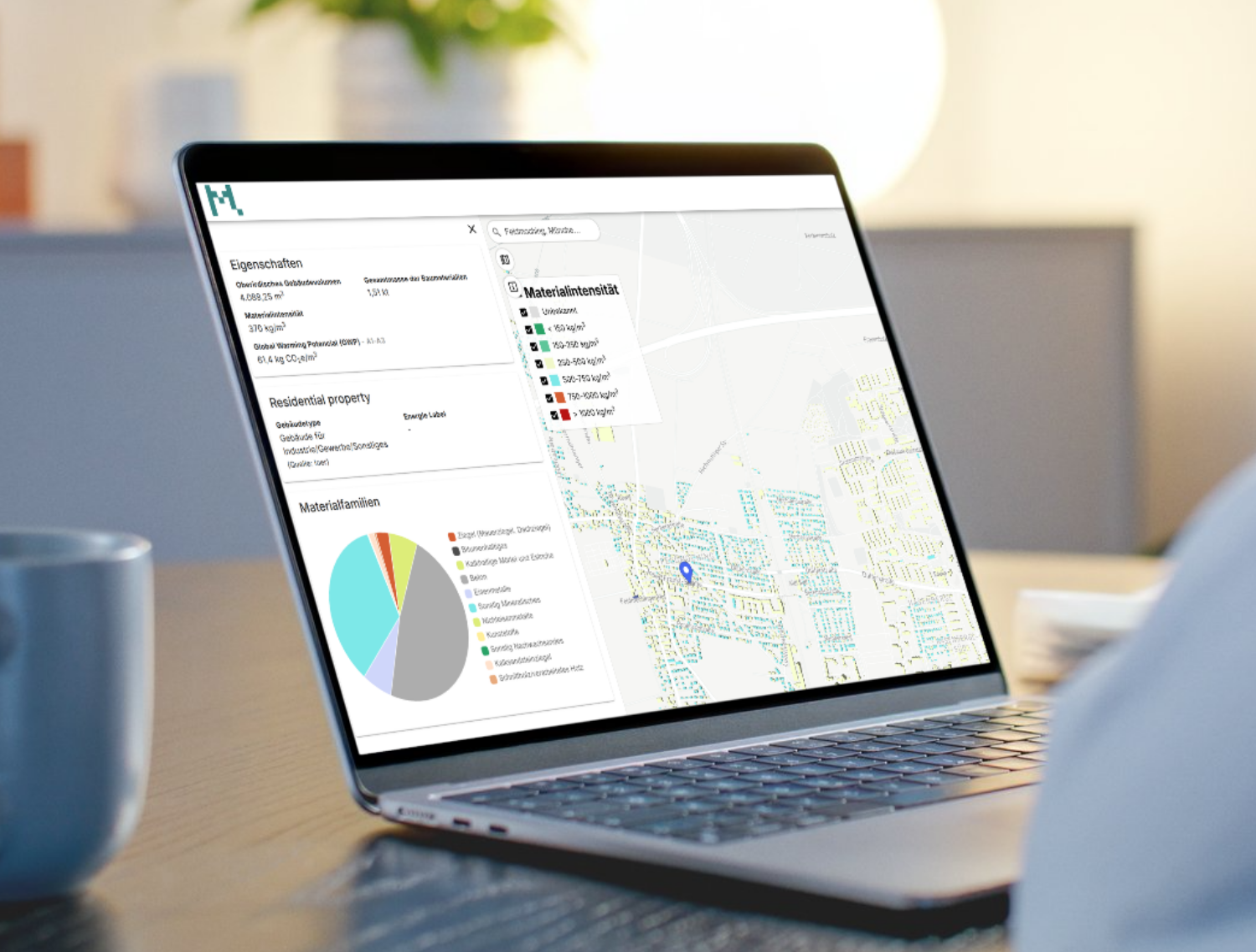
How much raw material is actually in our cities? As part of its zero waste strategy, the state capital of Munich is investigating this question with a pilot project aimed at bringing transparency to the building stock.
Together with EPEA GmbH — Part of Drees & Sommer and Madaster Germany, a first building materials register was set up for the Feldmoching-Hasenbergl district. Around 7,500 buildings were analysed.
Transparency as a basis for a circular economy
The construction sector is one of the biggest consumers of resources in Germany: Every year, more than 500 million tons of raw materials are used for buildings and infrastructure. At the same time, large amounts of waste are generated, often because materials from dismantling cannot be reused in high quality. A central reason for this is a lack of knowledge about the materials used. This is exactly where the pilot project comes in: It creates a data basis for better planning material flows in the future and using them in line with the circular economy.
Digital tool enables rapid material analyses
The basis of the project is the Urban Mining Screener, a digital analysis tool developed by EPEA and Madaster Germany. With just a few input data such as year of construction, building type and location, well-founded estimates of the material composition can be made. The result is a building materials register that not only makes the resources used visible, but also assesses their circular potential, for example with regard to reuse or recyclability.
Munich promotes zero waste in the construction sector
With this project, Munich is responding to its ambitious goals: By 2035, waste from private households should be reduced by 15 percent and the amount of residual waste by 35 percent. The construction sector plays a central role in this, as construction and demolition waste accounts for a significant proportion of total waste generation.
The planned “Building Materials Library for Munich” is one of the measures within the Zero Waste Strategy to recycle resources in the long term.
Pilot shows enormous raw material potential
The results from Feldmoching-Hasenbergl illustrate the potential of existing buildings:
These materials form an important urban raw material warehouse that can play an important role in the sustainable supply of the region in the future.
Next step: Active material flow management
However, data collection is just the start. The aim is to systematically manage the identified materials in the future — with a clear focus on resource conservation, CO₂ reduction and waste prevention.
The findings from the pilot project will now be discussed further within the city of Munich and transferred to other urban areas in the future. They can also usefully complement existing initiatives such as Circular Construction Finance (CircoFIN) or the Urban Mining Munich Initiative (UMMI).