
All questions about EU Taxonomy compliance answered at a glance.
The ProCA EU Taxonomy declaration provides all stakeholders involved in construction with a statement on how a product contributes to achieving EU Taxonomy building certification. A simple, structured and BIM-compatible representation of the required product data creates clear orientation and planning security.
With ProCA you can ensure that your products meet all relevant requirements. This saves time, creates credibility and enables a transparent presentation of product properties. This is all possible thanks to our 100% intelligent and automated service.
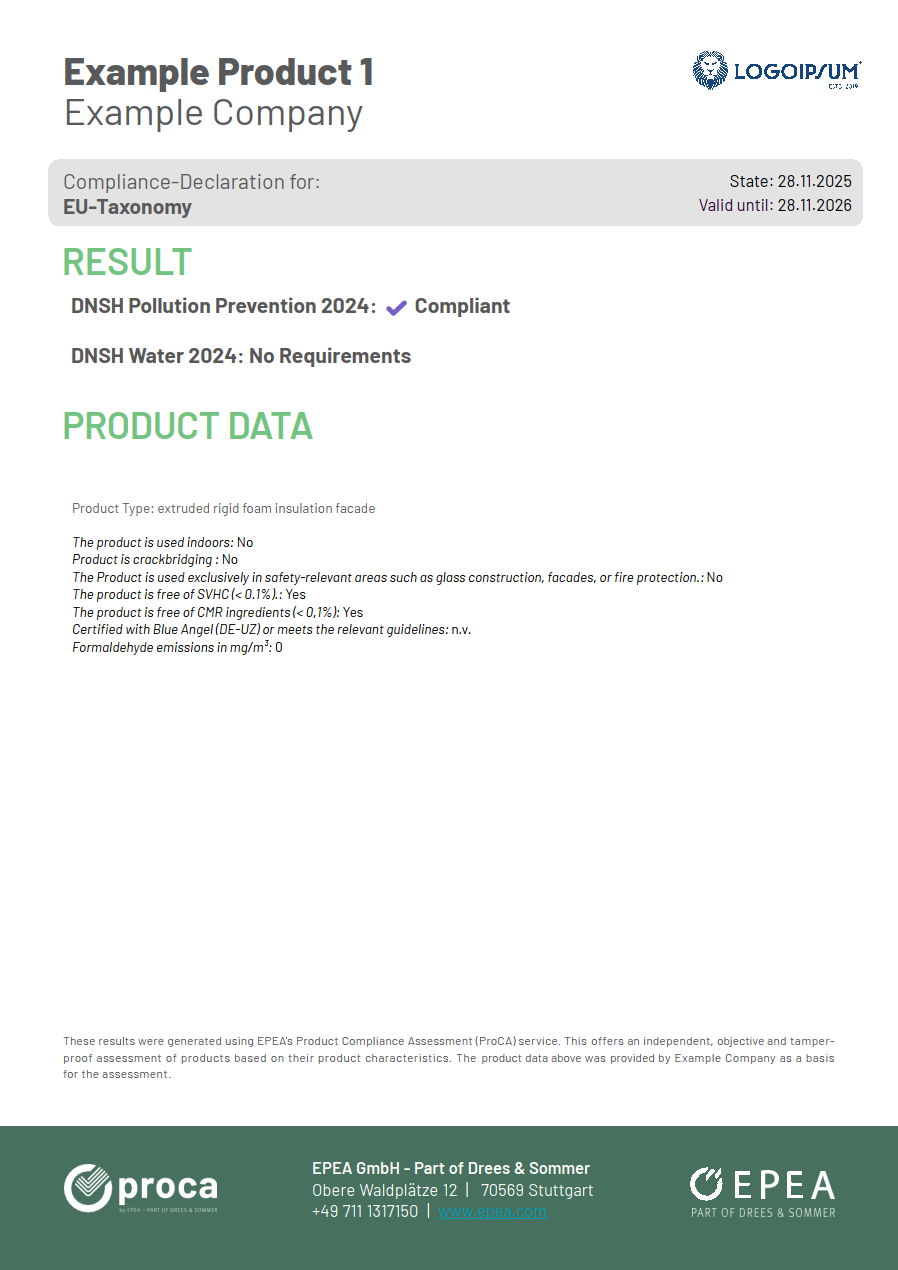
Since January 2022, some aspects of the EU Taxonomy Regulation (from June 2020) have already been in force, including both targets to reduce the environmental impact of the construction sector and concrete criteria for sustainable industrial activities. A total of six sustainability goals have been formulated to increase the sustainability of the industry: climate protection, adaptation to climate change, sustainable use of water resources, transition to a circular economy, prevention of pollution and protection of ecosystems and biodiversity. Construction projects and existing buildings in the areas of new construction, renovation, and acquisition and ownership can be certified or verified as EU Taxonomy-compliant. Three possible main goals have been defined for the construction sector: climate protection, climate change adaptation and circular economy. For the main goal, a significant contribution must be made through defined criteria. For the remaining five environmental goals, DNSH criteria must be met. These DNSH criteria (Do No Significant Harm, abbreviated DNSH) follow the principle that measures and activities must contribute to the respective environmental objective without running counter to the other environmental objectives. Furthermore, minimum protective measures must be observed in every economic activity. In principle, many of the points contained in the EU Taxonomy are also part of the DGNB certification. This means that if a DGNB certification is to be carried out, an additional EU Taxonomy verification only requires a relatively small amount of effort in terms of the evidence for the individual criteria, since a large part of the required data is already available through the DGNB assessment.
The following criteria set specific requirements for individual products and are therefore particularly important for construction product manufacturers:
DNSH environmental pollution criterion
Within these criteria, the focus is on assessing the material health of the products, particularly with regard to emissions. This results in specific emission limits for individual product groups. The focus is primarily on formaldehyde and proven carcinogenic (VOC 1A) and probably carcinogenic (VOC 1B) VOC emissions. As a rule of thumb, products that want to be considered EU Taxonomy-compliant must meet the same requirements that are necessary to achieve quality level 4/4 according to DGNB version 2023 within the framework of the DGNB's ENV 1.2 criterion. The criteria of the EU Taxonomy are to assess the SVHC content of a product. If SVHC values above 0.1% by mass are found, documentation with the exact concentration must be submitted. If the product does not contain any SVHC, this can be proven either by appropriate documentation (manufacturer's declaration or safety data sheet) in which the SVHC content is stated as less than 0.1%. The same requirement currently applies to construction projects that aim to receive the QNG (Sustainable Building Quality Seal) in connection with the KFN (Climate-Friendly New Building) funding. The CMR content of products is also assessed. This includes H340, H340i, H350, H350i, H360, and H360i. If the mass fraction of these substances is higher than 0.1%, documentation must be provided with the exact percentage. In EPEA's ProCA declarations, the EU Taxonomy criterion DNSH pollution is presented with a result of "compliant" or "non-compliant". Products for which no requirements in this criterion apply are presented with "no requirement".
DNSH water criterion
Within this criterion, the evaluation focuses on determining the efficiency of water use in the building itself. This includes, for example, the water flow rate of certain products that are installed and used in a building (such as showers or faucets). These efficiencies are assessed within proca. In accordance with the DNSH criteria for environmental pollution, there are similar requirements for products whose water efficiency has been assessed in accordance with the DGNB criteria ENV 2.2. In EPEA's ProCA declarations, the EU Taxonomy criterion DNSH water is rated as “compliant” or “not compliant.” Products that do not have requirements in this criterion are marked as “no requirement.”
In addition to the criteria mentioned above, there are a number of criteria on which construction products have an indirect influence. However, as there are no specific product quality requirements, these criteria are not addressed in the ProCA declarations.
DNSH Circular Economy Criterion
Within this criterion, the circulatory capacity of the building should be assessed, including whether demolition waste can be recycled or reused. For this purpose, individual products that are themselves designed to be recyclable and can be recycled or reused at the end of the life of the building can contribute to an overall rating. However, as there are no requirements at product-specific level, this criterion is not assessed in the ProCA statements.