
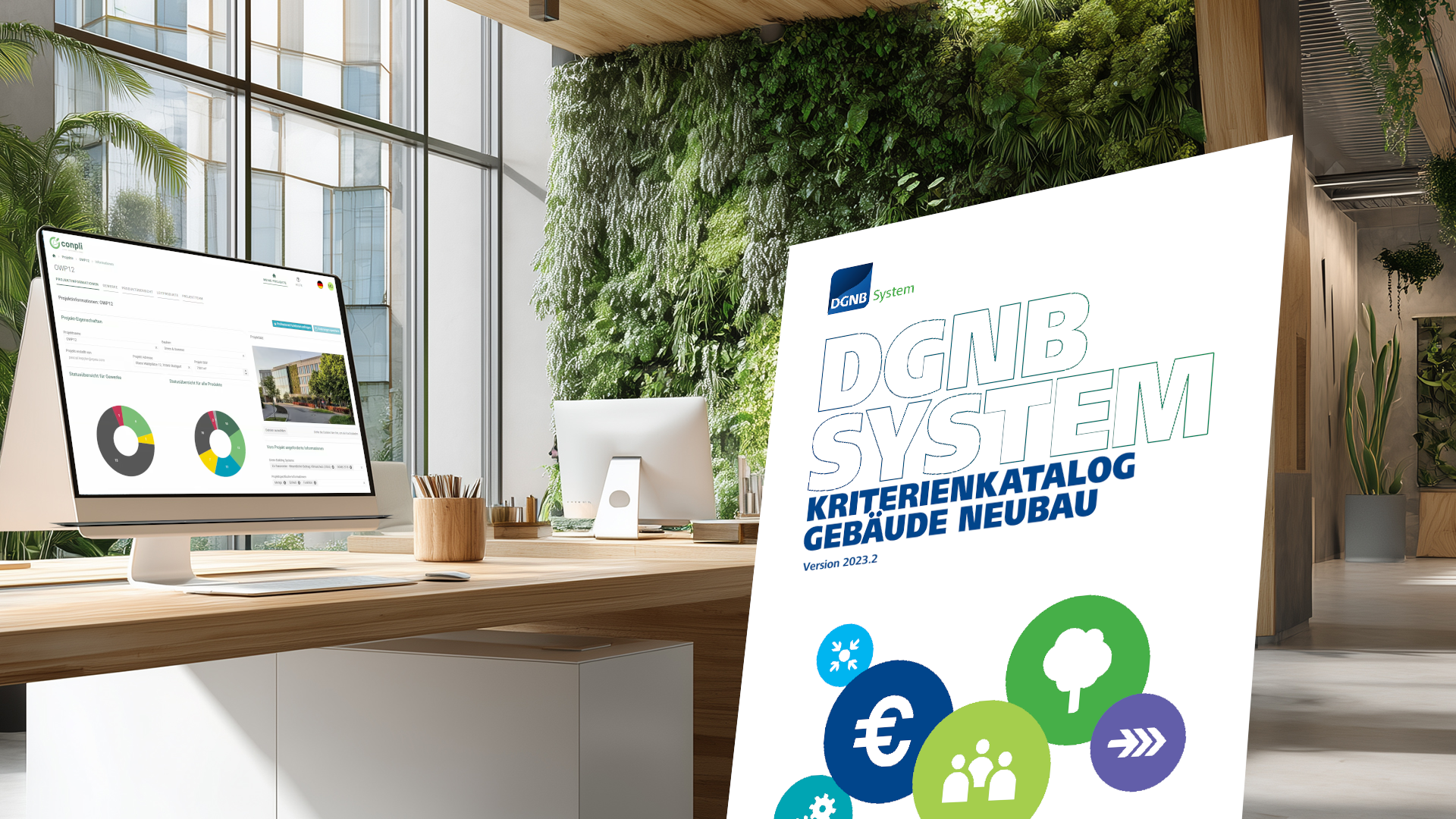
With version 2023.2, the German Sustainable Building Council (DGNB) has revised its certification system for new buildings. The criteria catalog was reviewed in a practical participation process with experienced auditors and significantly streamlined; the focus is now more strongly on the criteria that contribute most to sustainability quality. According to consulting practice, the catalog has shrunk from around 680 to a solid 550 pages. The final weighting table and the processing of criteria in the DGNB System Software have been available since the end of July 2026; the DGNB provides an overview of the key changes compared to version 2023 in its group for auditors and consultants. The version was already presented in a digital information event on May 12.
In terms of content, the version aims for less documentation effort while maintaining comparable sustainability quality. All indicators, verification methods, and the associated documentation requirements were critically reviewed for their impact, and the entry into certification is now facilitated in a less labor-intensive form. Some of the previous minimum requirements from version 2023 have been relaxed and converted into voluntary, point-rated requirements; a climate risk analysis of minimal scope remains mandatory, among other things. The DGNB Building Resource Passport and the circularity check in criterion TEC1.6 Circular Building are also newly rewarded.
The DGNB deliberately chose the name 2023.2 instead of 2026: those who are already doing the right thing should be able to continue and be provided with a suitable tool to do so – the background is the ongoing debate about debureaucratization in the construction industry. The reduction in effort and costs primarily affects fees for auditors and other services in the certification process; the DGNB's own certification fees remain unchanged. Regarding the schedule: registration for version 2023 is still possible until September 30, 2026; from October 1, 2026, version 2023.2 will completely replace the previous version. Projects already registered can switch upon request at no additional cost.
A special feature in criterion ENV1.2 is particularly relevant for product testing: the current criteria matrix (Annex 1) may be applied regardless of the registered system version, and individual rows of the version used can be switched to 2023.2. Projects therefore do not have to switch completely to the new version to benefit from the leaner system – the changeover is possible on a row-by-row basis.
This is exactly where conpli comes in. Version 2023.2 is now available as a separate certification system – it is not automatically active in all projects, but can be selected specifically as needed. This allows you to decide for each project whether and when to switch. Because individual rows of the criteria matrix can be evaluated according to 2023.2 across projects, projects on older versions also only look at the rows that are still included in 2023.2. Since the scope of the new version is reduced – for example, regarding requirements for factory-applied coatings – the number of items to be tested decreases noticeably.
Switching to version 2023.2 reduces the number of items to be verified and thus the effort required for product testing.
As part of the new version, we have also fundamentally simplified the system: overall, significantly less information needs to be provided. The underlying logic has been restructured and the number of fields to be filled out has been reduced. This shortens the verification process and keeps the testing status consistent across projects.
Those working with conpli can now select version 2023.2 on a project-by-project basis – a switch is possible without any additional setup effort. We are happy to answer questions about application to specific projects directly.